Evidence first
Every recommendation should explain the range, accuracy statement, response class, and integration requirement that made it fit.
Cognex is presented as an industrial sensing and inspection partner for teams that must translate plant reality into procurement records, installation notes, and audit-ready measurement files. The brand voice is technical, direct, and forward-looking because its buyers are engineers who answer to uptime dashboards and quality systems.
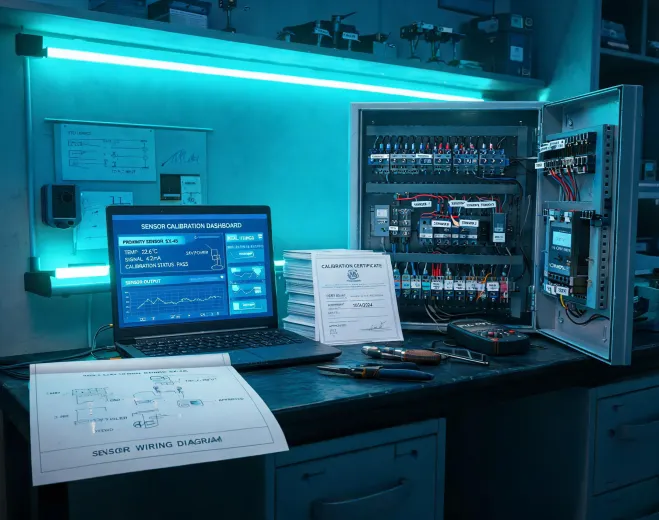
Industrial sensing often fails in the spaces between teams. A sourcing manager receives a part number, the controls engineer worries about the PLC input, the quality manager asks for calibration language, and the maintenance lead needs a replacement route that does not stop the line. Cognex organizes its site around that shared handoff. Instead of presenting a disconnected shelf of sensors, test tools, and inspection systems, the content explains how each category should be reviewed before it becomes an installed asset.
The approach starts with the actual measurement point. A photoelectric sensor on a packaging line may need a fast response and a bracket that survives washdown. A vision inspection system may need repeatable reject logic with traceable images. A handheld test instrument may need a stated accuracy class and a recalibration plan. Each situation changes the evidence package, so Cognex keeps range, accuracy, protocol, approval region, and service route visible throughout the buying conversation.
Configured around your range, accuracy class, and approval region.
Every recommendation should explain the range, accuracy statement, response class, and integration requirement that made it fit.
Protocol, power, cabling, enclosure, and mounting constraints are handled as purchasing requirements, not late installation surprises.
Calibration notes, traceability language, and approval-region details are prepared so customers can defend the selection later.
Availability, service routing, and replacement planning are kept in view because measurement assets drift, age, and move between lines.

A sensor that works in a lab can still fail a line review if its response time is too slow, its IP rating is wrong, or the approval mark does not match the plant location. A test meter with a strong headline may still create audit friction if uncertainty and traceability are unclear. Cognex treats these details as front-page content because they determine whether a buyer can standardize the product across multiple facilities.
This is especially important for automation, logistics, semiconductor, and renewable-energy buyers. Their projects involve repeat installations, fast changeovers, and cross-functional documentation. By presenting product categories together with measurement evidence, Cognex helps users compare alternatives without inventing assumptions after the fact.
Share the measurement point and the documentation your team needs. Cognex will help organize the next review around practical evidence.